
The vision was never yours to control. It was always His to complete.
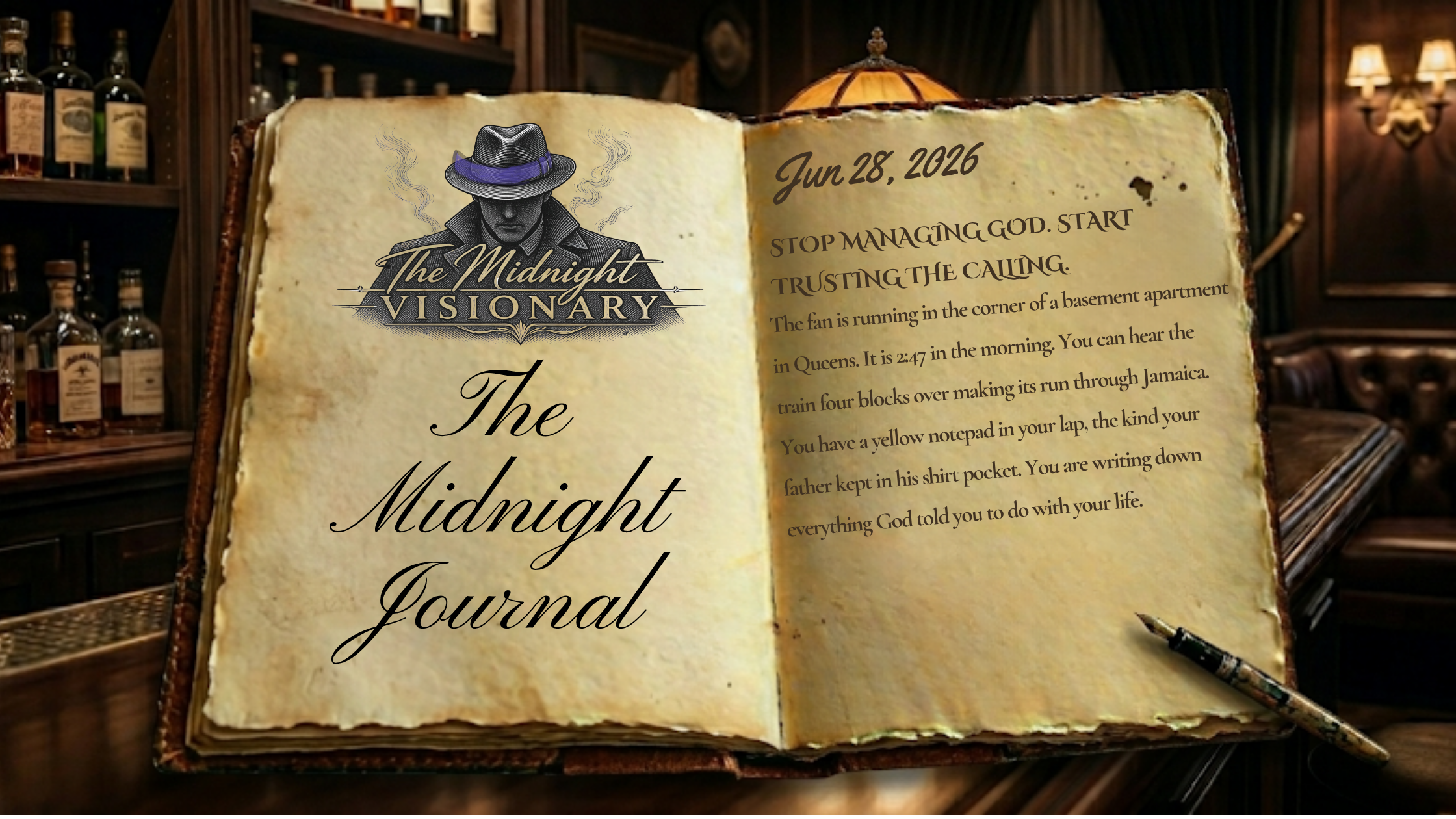
The fan is running in the corner of a basement apartment in Queens. It is 2:47 in the morning. You can hear the train four blocks over making its run through Jamaica. You have a yellow notepad in your lap, the kind your father kept in his shirt pocket. You are writing down everything God told you to do with your life. It takes three pages. You feel electric. You feel terrified. You feel chosen.
That was the beginning.
Now it is years later. The yellow notepad is gone. You have a Notion dashboard and a twelve-week launch calendar and a content strategy and a revenue forecast. You have team calls and brand guidelines and email sequences. You have built, in precise and careful order, a machine designed to produce the thing God handed you on a piece of yellow paper at 2:47 in the morning.
And somewhere between then and now, you stopped trusting Him and started managing the outcome yourself.
I know you felt it. That slow, creeping shift where the vision became the business. Where prayer started to feel like one more item in the morning routine instead of the source of everything. Where you started telling God what you needed instead of asking Him what He was doing.
This is not a failure. This is the test.
The Difference Between Calling and Control
Marcus Aurelius, emperor of Rome, wrote in his private journal, never meant to be published: “You have power over your mind, not outside events. Realize this, and you will find strength.”
He was talking about Stoic discipline. But he was, without knowing it, circling the same truth that Scripture has carried for thousands of years.
Proverbs 16:9. “A man’s heart plans his way, but the Lord directs his steps.”
Not a suggestion. Not a consolation prize for when your strategy fails. A declaration of how purpose actually works.
The calling is real. The vision God gave you is real. The work you are doing with it matters. And none of that contradicts the fact that the outcome, the timing, the path, belongs to Him and not to you.
The question is not whether you believe that intellectually. You do. You have it memorized. The question is whether you live like it on a Tuesday afternoon when your funnel is broken and your launch flopped and your best team member just quit.
That is where the theology becomes biography.
What My Yiayia Taught Me Without Knowing It
My grandmother came from a village in Greece where the church was the center of everything. Not the center of Sunday. The center of everything. Every harvest, every birth, every death, every decision about land and money and marriage ran through the Divine Liturgy, through the priest, through the saints on the icons that lined every wall of her house.
She came to America and brought that with her. Not as nostalgia. As operating system.
She would say, in her broken English: “Gabe, you work hard. But God, He decide.” And she would wave her hand in this particular way that meant: I am not being passive. I am being accurate.
She knew something I had to learn the hard way. There is a difference between the effort you give and the outcome you demand. Surrender is not inaction. Surrender is directing your full energy at the work while releasing your grip on the result.
Viktor Frankl, who survived what no human should survive, wrote that meaning is not manufactured. It is discovered. It is received.
You do not build your purpose from scratch. You receive it. And what is received can be returned to the Source when you have held it too tightly for too long.
The Night It Breaks Open
There is a moment, and I think you have had it or you are approaching it, where the whole structure you have built around the calling starts to feel hollow. Not bad. Not wrong. Hollow. Like a house that is perfectly constructed but not yet lived in.
That hollowness is not failure. That is God pressing against the walls you built without Him in the room.
Jesus said it plainly in John 15:5. “Apart from me you can do nothing.”
Not: without me your results will be suboptimal. Nothing.
That word lands differently at midnight, when the numbers are down and the content is not connecting and you are trying to remember why you started. It lands like an invitation. Like: come back to the source. You have been running on what I gave you in the beginning. Come and fill up again.
The hollow feeling is not the end of your calling. It is the beginning of the next level of surrender.
The Man Who Keeps Running the Same Play
There is a man I think about sometimes. I have never met him, but I know him the way you know a version of yourself you used to be.
He has a God-given vision. He has worked for it faithfully. He is disciplined, intentional, relentless. And he is quietly exhausted. Not from the work, but from the weight of trying to guarantee the outcome of something God never gave him permission to guarantee.
He keeps running the same play because the play is good. It is a good play. It came from a real place. But God has been trying to shift the formation, and this man keeps calling audibles back to the original plan, because the original plan feels safe and the new direction feels uncertain.
The play is not the problem. The grip is.
Surrender, real surrender, is not giving up the vision. It is giving up the illusion that you are the one keeping it alive.
The Midnight Move
Tonight, one thing.
Go back to the place where you first received it. The notepad. The car. The church pew. The conversation. The voice memo you recorded at 3am because you were afraid you would forget what God said.
Spend ten minutes there. Not planning. Not reviewing metrics. Just remembering.
Remembering who gave this to you. And why. And what He said He would do.
Then say it out loud. I do not care if you are alone in your car or in your office or sitting on the floor of your bathroom. Say it out loud.
This belongs to You. I am still available. Direct my steps.
Then close the laptop. Put down the phone. And go to sleep trusting that the God who woke you up at 3am with a vision did not hand it to you so you could carry it alone.
Philippians 1:6. “Being confident of this, that He who began a good work in you will carry it on to completion until the day of Christ Jesus.”
That is not poetry. That is a contract. And He does not break contracts.
Rest in it tonight.
What’s forged at midnight cannot be broken by the dawn.
— Gabriel Vangelatos, The Midnight Visionary